On Gore
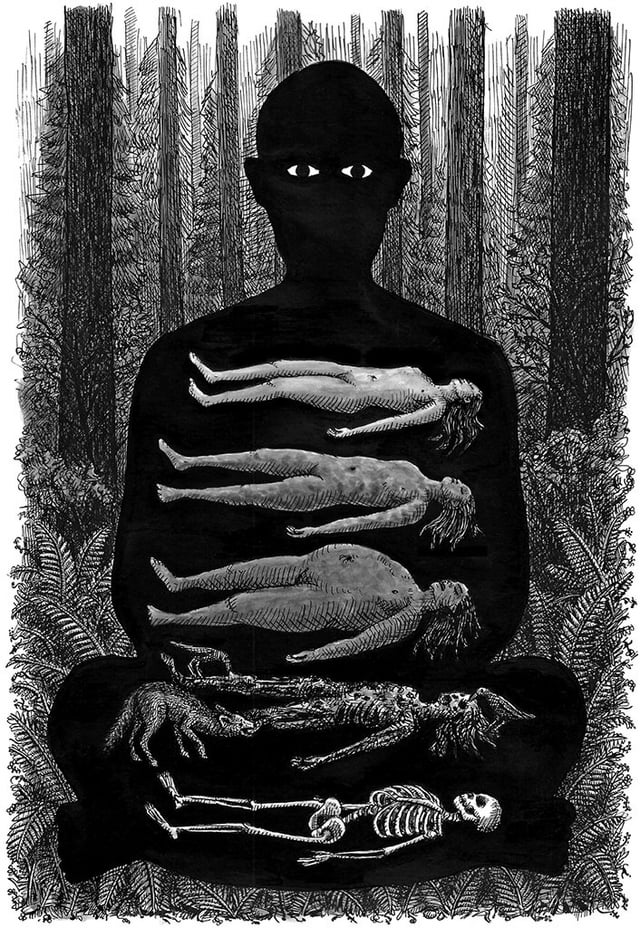
Aka; the potential of seeing footage of death for greater empathetic and spiritual development
When we hear the word ‘Gore’ we often have our own assumption of what it means. Often it is associated with shock value and a lack of respect for life, of the grotesque, the unethical, and the unhealthy obsession of bottom dwellers who act as living hungry ghosts looking into the suffering of fellow sentient beings. But I would like to separate that type of consumption of gore from this discussion and move onto the historical and practical use of it.
To quote from the Nirvana Sutra:
“This
body is a conglomeration of more than
eighty-four defective
elements.
This body is food for eight hundred and forty
million
worms.
This body is pervaded with the impure ordure of
a royal
dungeon.
This body is more disgusting than the
putrefaction of
the stinking corpse of a dog.
This body oozes impurities from
its nine orifices.
This body is like a citadel with plastering
of flesh, sinews, bones, blood and skin, outer
gates, ramparts and
turrets of arms and legs, a tower of the head,
and a king of the
mind.
This body is abandoned by all the wise, but for
immature
people it is a home for the millions of
flesh-eating demons that are
the afflictions of attachment, anger and
stupidity which cause them
to become infatuated with it.
It is devoid of any solid core
like a reed, a castor-oil shrub, a bubble or a
plantain tree; it is
extremely insubstantial like lightning or the
waves upon a steep
mountain stream; it is deceptive like an
illusion, a mirage, an echo
or a reflection of the moon... Who could take
pleasure in embracing
such a body?”
This scriptural quote is as simple as it is profound. It informs us of the body’s vulnerability and fate, not only to the elements and old age, but also to our own self-delusion.
Taking this scripture to heart and reciting it mentally allows us to internalize its teaching, guarding us against cherishing ourselves and instead setting our intention to acquire Buddha-hood. We can also be assisted by gore beyond the simple reminder of our mortality, but also to be grateful for our life right now.
When we see gore videos we plainly see how sensitive the body is and the corresponding fragility of life it entails. We secure ourselves in the anxiety of old age and the death that follows but we misunderstand that life too is unpredictable. To be hit by a car, to be struck by falling rubble from a building, our bodies are fragile — bones break, organs fail and bleed internally, our arms separate painfully and our bones can protrude out of our bodies as if stabbed from the inside .This is not to grow paranoid, as it would be fruitless, but instead to have a simple appreciation of the life we have now and its vulnerability. Witnessing such things can help us appreciate life more and live it in a guarded and safe way. Seeing such footage lets us see firsthand this reality. Simple visualization can take place afterwards but to see its sudden force and effect with no pulling of punches gives us no ground to stop and grow paranoid. Instead we see the equality of such events and how fruitless it is to worry to the extent of suffering. Rather, we should be safe and meditate on our precious human birth.
Our precious human birth?
Yes! Your human birth is indeed precious — be you crippled, disabled, poor or sick, it is indeed precious and rare in this world! Think of how common life is in the animal kingdom and across the world, from countless lower births like roundworms to the countless unknown fish in our seas. To be born now in human form is a blessing. It gives us the chance to read Dharma books, to listen to Dharma lectures, to meditate on the Dharma and most of all it allows us to visualize the process after death.
Visualize the chaos of a rough dream. The suddenness of such death leaves the unprepared in a haze of a fever dream thrown by storms and tides charged by karmic results that can send us up into the heavens or drag us down, separate us from loved ones, pushing us in uncountable directions. It shows us the importance of human life and that such a rare opportunity lets us understand the teachings. It tells us the importance of taking refuge in the Three Gems and of the very meaning of refuge — a refuge from the haze and chaotic storm of rebirth to guide us calmly to realms away from the lower births and lower realms. Our bad karma is cast away through our refuge, a sense of catching our breath in the countless waves, letting us set sail to the heavens and the Pure Lands in which we can, with proper faith, even reunite with our loved ones at the most blissful shore of a Pure Land. It lets us avoid lower births.
What
are lower births?
To be born in the animal kingdom. We
look ignorantly at nature in its best moments of
chirping birds and
the wind cooling the harsh warmth delivered by the
sun. We fail to
see the plain suffering there too at an unprecedented
scale. We
cannot with our human eyes see the suffering of the
insects and the
creatures deeper within the woods, but now with the
ability of media,
for example in a nature documentary, we can see it in
its full
truthful brutality.
We can see that the animal world suffers needlessly compared to that of a human: the deer screaming as a bear tears into its entrails while it is still alive and in horror, the deer stuck under a tree to be feasted on by other beings, only for such predators to be feasted on by other predators, the rotting of the salmon fish who rot alive and fall apart with the smallest of motions, or the plucking of eyeballs by birds. This lets us see the suffering of nature even without our input like hunting and the like, but instead see how fortunate it is for us now to be born as a human! To not suffer as much as the deer in the bear’s maw or the salmon rotting in despair, we can appreciate our human birth even more and strive to take this opportunity we have now! It lets us too see the fruits of karmic results — that to even escape birth as a hungry ghost or a hell dweller does not mean we are lucky and free from suffering. It may mean we are to be born as an animal. Once more, the importance of refuge and spiritual development is further upheld.
To return focus on human death, if one watches said suffering, watches the accidents and the suddenness of it, we can better meditate and appreciate it. Here I will quote from a book I read, ‘The Sweet Dews of Chan’, that had a meditation ripe for this opportunity:
“Newly
Deceased: The corpse retains a lifelike pallor
shortly after death,
with features intact and skin unmarred,
symbolizing the abrupt
cessation of vital functions; the body may be
shown laid out indoors
or in mourning attire, evoking the initial shock
of mortality before
rigor mortis fully sets in.[2]
• Distension: Within days,
gases from internal bacterial activity cause the
abdomen and limbs to
swell grotesquely, distorting the once-familiar
form and highlighting
the body's betrayal by its own physiology; this
phase, occurring
around the third to fifth day postmortem in
temperate conditions,
marks the onset of autolysis.[2]
• Rupture: Pressure from
bloating splits the skin, particularly across
the torso, allowing
fluids to seep; this rupture exposes underlying
tissues and
accelerates exposure to environmental factors,
typically evident by
the end of the first week.[2]
• Exudation of Blood: Crimson
fluids and liquefied blood ooze from incisions
in the epidermis,
staining the surrounding ground; this vivid
leakage, driven by
hemolysis and putrefactive bacteria, intensifies
the visual horror
and occurs concurrently with early tissue
breakdown.[2]
•
Putrefaction: The body softens into a
suppurating mass, with maggots
emerging from orifices and insects infesting the
decaying flesh;
enzymatic and microbial action liquefies organs,
producing a fetid
odor and waxy residue, often depicted as the
corpse resembling melted
tallow by the second week.[2]
• Discoloration and Desiccation:
Remaining skin darkens to bluish-black hues from
marbling
(intravascular hemolysis), while exposed areas
mummify and shrink;
this drying phase follows fluid loss, leaving a
desiccated shell with
protruding bones, varying by climate but
hastened in arid
conditions.[2]
• Consumption by Birds and Animals: Scavengers
such as crows, dogs, and insects devour the
softened remains,
stripping flesh from limbs and torso; this stage
illustrates
ecological recycling, with the body fragmented
outdoors in fields or
graveyards, emphasizing vulnerability to natural
predation.[2]
•
Skeletonization: Soft tissues fully slough away,
revealing an
articulated skeleton bound by ligaments;
weathering and further
scavenging loosen joints, representing the
endpoint of organic decay
after months, though tendons may persist longer
in cooler
environments.[2]
• Disjointing or Memorial Relics: Bones
scatter and bleach under exposure, eventually
crumbling to dust or
marked by a tomb such as a gorintō (five-element
stupa) inscribed
with the deceased's posthumous name; this final
dissolution
symbolizes ultimate impermanence, with relics
evoking the soul's
transcendence beyond the corporeal.[2][8]”
Do not sickly look onto it to suffer, but instead watch such things to see the fragility of life and its importance and rare opportunity. This way we can use gore media for the ability to develop empathy to other people and to sentient beings universally. To meditate on the hunger of the world we can meditate while hungry, visualizing ourselves feeding starving families of tigers as bodhisattvas in the past have done. To take the fall of hit-and-runs for beings who could never thank us. To meditate on such things aspires us to be born a bodhisattva for the sake of all sentient beings.
How can we begin if we stay as sheltered as to not realize the fragility of our human form?
Namu Myōhō Renge Kyō!